
40% rise in weekly cyber attacks

analyst ict cybersecurity awareness training

In the second quarter of 2022, the average number of weekly cyber attacks* worldwide increased by 32 percent, compared to the same quarter last year. This reached a peak of an average of 1,200 weekly attacks per organization. In the Netherlands, an increase of 40 percent was measured. This is according to research by security provider Check Point.

The Education/Research sector is the most attacked globally, averaging more than 2,300 attacks per organization per week. This is a 53 percent increase from the second quarter of 2021. Healthcare saw a 60 percent increase in cyber attacks over the same period to 1342 attacks per organization per week.

Africa is the most attacked region in the second quarter of 2022, peaking at an average of nearly 1,800 weekly attacks per organization, up 3 percent from the same period last year for this continent. After Africa, Asia and Latin America follow with an average of nearly 1,700 and 1,600 attacks, up 25 and 29 percent, respectively, from last year.

Latin America saw the largest increase in attacks, with 1 in 23 organizations affected weekly, an increase of 43 percent, compared to 1 in 33 in the second quarter of 2021. Followed by the Asia region, where the number of attacks increased 33 percent, to 1 in 17 organizations affected each week.

The retail and wholesale sector saw the biggest spike in ransomware attacks, up 182 percent compared to the same period last year, followed by the distribution sector which saw a 143 percent increase. The government/defense sector also saw a sizable increase of 135 percent, marking 1 in 24 organizations hit by ransomware on a weekly basis.

Time to take action? At Analyst ICT we have developed a super logical “security scan” which we will gladly come to your organization to perform and press on-site. Interested? Take contact with us.
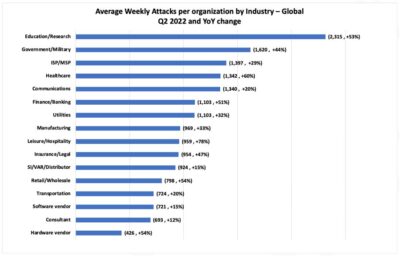
*Cyber attacks come in different shapes and sizes. From a computer virus or a hack to a DDoS attack, for example, targeting energy supplies or other vital systems. Cyber attacks therefore pose a risk to individual Internet users and national security.

Source: Weekly number of cyber attacks in the Netherlands up 40 percent - Emerce

Recent blogs

apple header
Blog
Apple 50 Years: 50 Years of Daring to Think Differently
This year, Apple celebrates its 50th anniversary. A milestone that cannot simply be overlooked. Because whether you are a fan or not: Apple has permanently changed the way we work, communicate, and create. At Analyst ICT, we are proud to be part of this ecosystem. As an Apple Technical Partner, we work daily with technology that is not only powerful but, above all, logical and pleasant to use. A different perspective on technology Apple has always distinguished itself by one simple conviction: technology should help people, not hinder them. No unnecessary complexity, but simplicity and ease of use. That aligns seamlessly...
browser password
Blog
Why saving passwords in your browser is not a good idea
The blog post below was created in response to a question during our engineering meeting. Every two weeks, we get together with all of our technical staff to discuss the latest developments in technology or with clients. Good client questions also arise during these meetings, such as this one. Time to do some research. Thank you, Wiebe! You've probably experienced this: you log in to a website, and your browser asks if it should remember your password. Convenient, fast, and you don't have to remember anything. However, there's a risk involved. In practice, we see that many security incidents start with something small. Like saving passwords…
Apple Business
Blog
Apple is taking a big step with Apple Business
Apple announced something special this week. Not a new device, but something that might be even more interesting for many organizations: Apple Business. A completely new platform with which Apple brings all its business services together in one environment. And frankly: this is a development that we at Analyst ICT are following with great interest. The problem: fragmented tools and unnecessary complexity Many organizations working with Apple will recognize the problem: Multiple portals (Apple Business Manager, Business Essentials, Connect) Different tools for management, branding, and support Additional costs for basic functionalities such as device management This leads to a lack of clarity and costs time. And…

A newsletter

Superlogic right?