
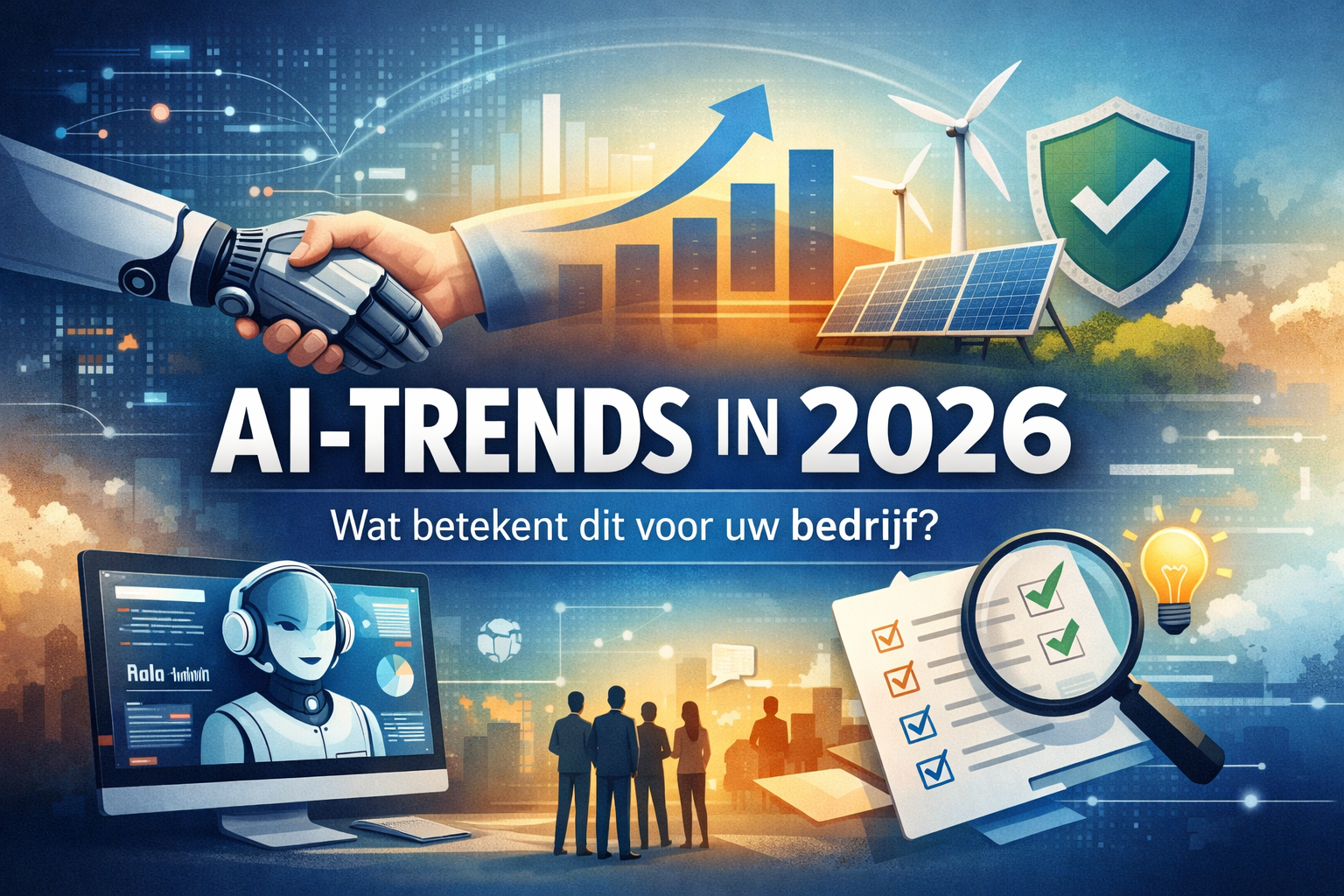
2026 will be the year when artificial intelligence is no longer just an experiment, but truly part of how organizations work, decide and grow. At Analyst ICT, we see that these trends are not only of interest to large corporates, but precisely Have relevance to SMEs: from productivity improvements to smarter collaboration and better data decisions. Below, we lay them out practically for you.
1. From generative tools to autonomous AI agents
By 2026, AI will shift from tools that primarily provide responses - such as text or code generation - to autonomous agents that independently perform tasks and drive workflows. In practice, this means that AI not only helps, but can actively take over work if you set the right frameworks for it.
What does this mean for you?
- Consider automated document processing, customer service tasks or scheduling work that runs without much human supervision.
- Not just efficiency; it gives your team space to focus on what really makes a difference for your customers.
2. The human factor remains indispensable
AI is getting smarter, but people continue to bring nuance, context and empathy that systems lack. AI is best used as a tool - not as a replacement.
Tip: Combine AI with human oversight, especially in customer communications, decision making and quality control.
3. Conscious choice: what do you trust AI with?
It is increasingly important to make targeted determinations What tasks you transfer to AI and which ones you want to keep for yourself. This helps you avoid investing in technology based on vague expectations that yield little return.
Starting point: Make a list of repetitive processes within your organization - are there steps that AI can reliably perform?
4. Reliable data is worth its weight in gold
AI only performs well based on good data. In 2026, more attention will be paid to legally clean, reliable datasets On which AI is trained.
Practical step: Ensure your enterprise data is structured, consistent and compliant. This reduces risk and improves the results of AI applications.
5. Sector-specific AI models gaining ground
Instead of a single generic AI model for everyone, arose AI models tailored to specific sectors - for example, health care, financial services or government.
Benefit to you: more reliable results and better alignment with your industry requirements and regulations.
6. Usability: AI gets easier
Tools are becoming more intuitive: you don't need to be an AI expert to get value from AI applications. Consider visual interfaces, voice activated features and contextual support.
Consequence: organizations without large ICT teams can start AI projects faster.
7. From hype to measurable value
2026 is the year of truth: organizations are eager to see what AI actually delivers. AI should not only be cool, but value-added.
Approach: Develop an AI roadmap with clear KPIs - such as time savings, error reduction or customer satisfaction.
8. Sustainability gets attention
AI use requires a lot of energy and computing power. Companies are becoming more conscious of AI use and aligning choices with sustainability.
Smart tip: monitor AI usage and choose efficient, energy-efficient services whenever possible.
9. Culture and adoption determine success
Perhaps the most important trend: Organizational culture determines whether AI is successful or not. Technology alone is not enough - people must want to accept AI and learn to work with it.
Opinion: Invest in training and change management so that AI is not only available, but carried by your team.
What does this mean for your organization?
AI in 2026 is no longer a faraway show - it will become an integral part of how businesses operate. But success does not depend on technology alone, but rather:
- Clear goals and KPIs
- Reliable data and governance
- Human-AI collaboration focused on value
- Culture and adoption within your organization
At Analyst ICT, we are happy to help you with the determining realistic AI capabilities, the structuring data and processes, and the creating a roadmap that matches your goals.
AI is not a panacea - but with the right approach, it can really move you forward.