
There are those contradictions in life where opinions are invariably tightly defined. This is also often the case when it comes to the computer you work with: you are either for the PC, or you swear by the Mac. If you belong to the latter group, then you can stop reading now. For all businesses hesitating between Apple or Windows: five reasons to switch to the Mac. We do make the note that not every organization is suited for Mac, and that can be for several reasons. We wouldn't be an Analyst ICT if we didn't analyze first and then start! #superlogical
1. Mac for less!
That a Mac is considerably more expensive than Windows is probably the biggest misconception about the Mac. Indeed, the price tag of an average Mac is higher than a PC - assuming the same processor, similar graphics capabilities, and the same amount of memory and storage. But if you look a little further, the differences are much smaller, especially if you're up for new computers anyway.
If you look purely at the purchase, the main issue is the residual value. Economically speaking, this is about 10 percent for a PC after three years, whereas it is at least 25 percent for a Mac. And if you look at the private sale value, it is a multiple of that.
By the way, there is no reason to get rid of a Mac so soon. Apple supports models for at least 5 years and often up to 7 years. And even after that, you can still get several years ahead with free operating system updates.
With a PC, you basically get Windows 11 Home by default. But it lacks some essential features for corporate environments. For example, for remote management. Security is also minimal. For example, BitLocker (encryption for files), Windows Defender (antivirus and antimalware) are missing. For that you need Windows 11 Pro, where a license easily costs 200 euros or more.
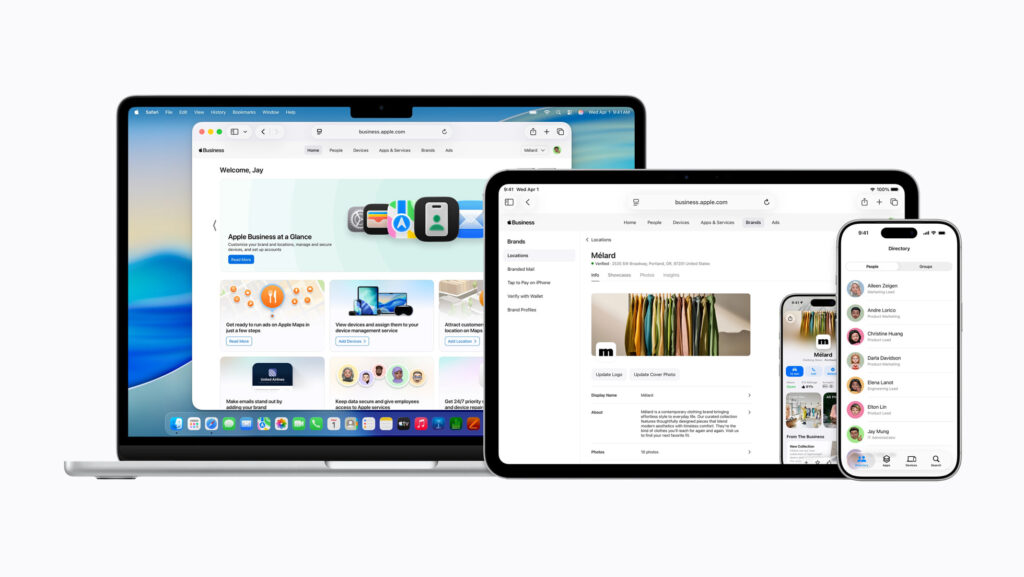
With more than say ten computers, you need something like management. With macOS, that's built in by default. With it, you can easily use a third-party tool to manage your entire computer park: roll out updates and apps, set permissions, and remotely wipe the Mac if it goes missing for any reason.
2. Operational costs
In addition to purchase costs, licensing costs and so on, there are of course so-called ‘operational costs. The costs you incur to keep the computer running, running updates and troubleshooting problems. You already feel it coming, these costs are significantly lower on a Mac than on a PC.
How about that? For starters, it's much easier to get a Mac up and running. It's a matter of turning it on, going through a few steps, and done. Within corporate environments, those steps can be very easily indicated centrally using Mobile Device Management, a management environment built into macOS by default. (Also in iOS and iPadOS, by the way.) Think about automatically creating an Apple ID and user identities for a Windows environment, creating network permissions and connections, and immediately downloading and installing the right apps on first use.
But for businesses, the biggest gain is in support time. Windows users appear to encounter problems more often than Mac users, about six times versus once or twice a year. Moreover, problems on the Mac appear to be resolved more quickly and easily.
Even if you do not have an IT department and only have a few Macs in your company, you will find that the Mac is simply easier and more intuitive to use, and you rarely run into serious problems.
These facts of points 1 and 2, by the way, are amply supported by a research report by analyst firm Forrester. Very much worth reading.
3. No hassle with software and drivers
macOS, by the way, is a standard part of the Mac. You buy the operating system for the entire life of the computer with all future updates included. For example, you can still install macOS 12 Monterey even on the MacBook Pro, MacBook Air from 2015 and the Mac Pro from 2013. Free.
Because hardware and software are so seamlessly matched, virtually all software and accessories work without additional actions. Installing a driver? Mac users don't know that for USB or Bluetooth devices such as mice, keyboards, docking stations, sound cards. For many other devices such as printers, macOS has a driver by default.
4. Your employees prefer to work on a Mac (and so do you!).
There is always a bit of controversy between Windows and Mac users, but when you ask them straight up, most employees unequivocally choose a Mac. That's exactly what researchers did. In 2018, Jamf, a company that makes software for managing Apple devices, wanted to know if companies give employees a choice of which device they prefer to work on. And what these employees then chose.
And it turns out that of the companies where there is choice, a whopping 72 percent choose Apple. (This includes not only the computer, by the way, but also the smartphone and tablet.) The survey also shows that these are mostly ‘millennials,’ young professionals who have grown up surrounded by digital devices.
And let that be the age group in which the new generation of professionals are to be found that is sorely lacking within organizations. Companies have to pull out all the stops to attract these people and to retain them. Free choice of equipment is a not unimportant part of this. Over 55 percent of the larger companies already offer their employees the opportunity to choose for themselves.
Of course, the choice of Apple or Windows may be difficult because certain Windows software is indispensable for your business. Fortunately, you can always install Windows on your Mac. On Mac computers with an Intel processor, you can use bootcamp, where you install Windows alongside macOS. When you boot up the computer, you can then choose whether to start the Mac in macOS or Windows. You can also choose to install Windows in a so-called ‘virtual machine. This can be done with Parallels or VMware, for example. The latter is also possible on the new Mac computers with an M1 or M2 processor.
5. A Mac is more secure
It is a bit lame to come right back to the Mac with the fact that macOS is not susceptible to viruses and malware. This was true for a long time, but with its rising popularity, the platform has also become more attractive to criminals. But while there is thus some danger, it remains unnecessary for Mac users to install separate software that filters out culprits among apps. After all, that's built into the operating system itself by default, including automatic updates.
In addition, macOS only allows you to install software from Apple-registered creators. Unknown software can only be installed through a workaround, which is a bridge too far for many users, so as an administrator or business owner you need not fear that.
Sensitive information can also be stored encrypted using FileVault. So should the Mac accidentally fall into the wrong hands, data remains inaccessible to those who have no business there.
Key points
At the bottom line, it appears to be more attractive for many companies to choose the Mac by default.
A few more key points:
- Lower operating costs
- Higher residual value
- Employees choose Mac when given the choice
- Mac is safer
- Mac is easier to use
- Less support is needed
But also take a moment to consider the new generation