
Making network cable

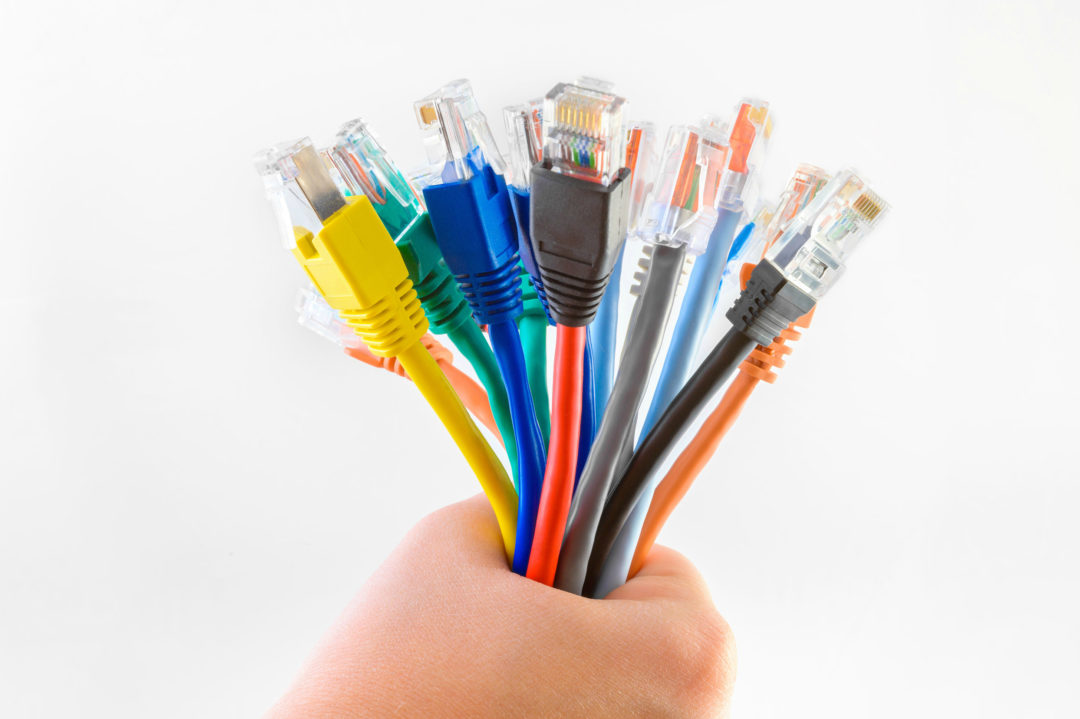
Want to make / crimp a network cable yourself or extend a network cable? On this page we explain how to do this. For your business environment, we recommend having an e-installer do this. They can also certify and test the network points.

Network cable color code

This blog provides information on the different standards for network cables, with CAT6a and CAT5e being the most common types. CAT5e network cables support speeds of up to 1,000 Mbps (1 Gigabit), while CAT6a cables can reach speeds of up to 10,000 Mbps (10 Gigabit).

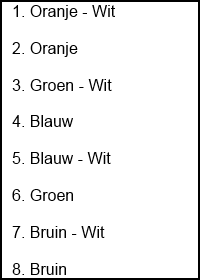
Both types of cables consist of 8 cores and follow the same color scheme for connections. This ensures uniformity and compatibility when installing your network infrastructure, regardless of the speed and type of cable chosen.
       

RJ-45 plug assembly

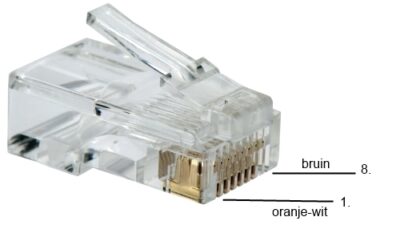
As you can see from the image below, making a network cable is a piece of cake. After you get the colors in the right order, use RJ-45 Crimping Pliers to connect the cable to the RJ-45 plug. Inside the RJ-45 plug are small teeth that push through the sheath of the 8 wires so you don't have to strip them beforehand.
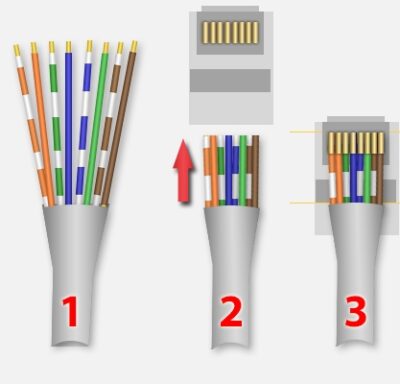
Insert the 8 wires into the RJ-45 connector in the correct order, then place the connector in the crimping tool and squeeze it closed. If all went well, the cable is then ready for use.

UTP Cable with hard or soft core icm an LSA socket

If you are using a wall outlet with LSA strip, please note that in this case only hard-core UTP cables can be used.
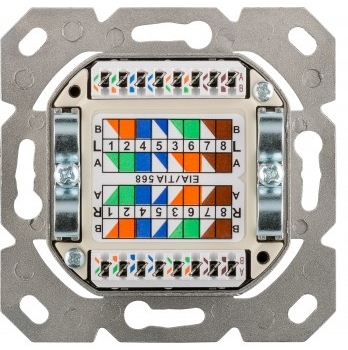
Using an LSA punchdown tool in conjunction with soft-core UTP cables can lead to speed problems. A common issue is that the soft core material does not always make good contact in the LSA strip, which can result in speeds that drop to as low as 10 Mbps.

To achieve higher speeds, such as 1 Gbps or 10 Gbps, we strongly recommend using hard-core UTP cables. These are better suited for a solid connection in an LSA wall outlet, ensuring reliable and fast data traffic.

Need help?

Are you going to build, renovate, build new, we from Analyst ICT like to think along with you about which connections should go where. We also work together with a large number of different e-installers with whom we would like to put you in contact.


Recent blogs

apple header
Blog
Apple 50 Years: 50 Years of Daring to Think Differently
This year, Apple celebrates its 50th anniversary. A milestone that cannot simply be overlooked. Because whether you are a fan or not: Apple has permanently changed the way we work, communicate, and create. At Analyst ICT, we are proud to be part of this ecosystem. As an Apple Technical Partner, we work daily with technology that is not only powerful but, above all, logical and pleasant to use. A different perspective on technology Apple has always distinguished itself by one simple conviction: technology should help people, not hinder them. No unnecessary complexity, but simplicity and ease of use. That aligns seamlessly...
browser password
Blog
Why saving passwords in your browser is not a good idea
The blog post below was created in response to a question during our engineering meeting. Every two weeks, we get together with all of our technical staff to discuss the latest developments in technology or with clients. Good client questions also arise during these meetings, such as this one. Time to do some research. Thank you, Wiebe! You've probably experienced this: you log in to a website, and your browser asks if it should remember your password. Convenient, fast, and you don't have to remember anything. However, there's a risk involved. In practice, we see that many security incidents start with something small. Like saving passwords…
Apple Business
Blog
Apple is taking a big step with Apple Business
Apple announced something special this week. Not a new device, but something that might be even more interesting for many organizations: Apple Business. A completely new platform with which Apple brings all its business services together in one environment. And frankly: this is a development that we at Analyst ICT are following with great interest. The problem: fragmented tools and unnecessary complexity Many organizations working with Apple will recognize the problem: Multiple portals (Apple Business Manager, Business Essentials, Connect) Different tools for management, branding, and support Additional costs for basic functionalities such as device management This leads to a lack of clarity and costs time. And…

A newsletter

Superlogic right?